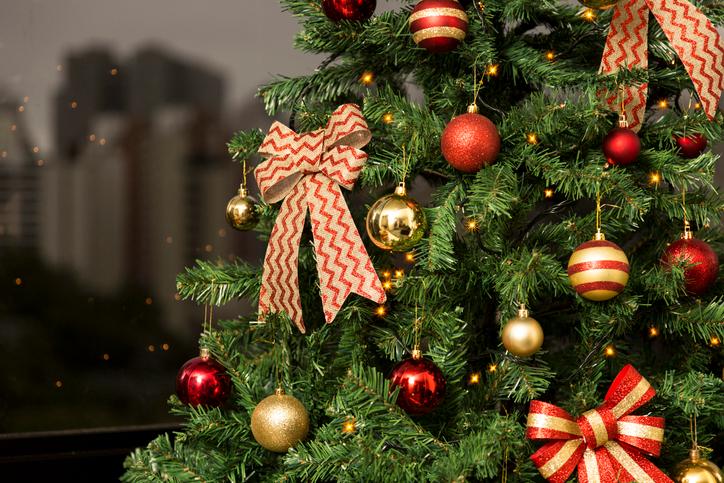
Real live Christmas tree: pros
Health benefits. Even though the tree has been cut down, photosynthesis occurs while its needles are still green. Additionally, the tree produces oxygen and beneficial natural oils like phytoncides, which:
- Significantly increase the number and activity of natural killer (NK) cells, which fight viral infections and increase the activity of anti-cancer proteins
- Reduce levels of the stress hormone cortisol to help relax, and improve sleep
- Reduce stress, anxiety, and fatigue
- Lower blood pressure and heart rate
Don't place your Christmas tree near a radiator, fireplace, or heater, and water it regularly. This will help the tree last longer.
Requires fewer resources. It takes about 7 years to grow an average-sized Christmas tree, and as it grows, the trees absorb carbon and use 10 times fewer resources than artificial Christmas tree factories. According to the Christmas Tree Manufacturers Association, 1 to 3 new saplings are planted for every tree cut down each year.
Real live Christmas tree: cons
May cause allergies. People prone to allergies are at high risk of developing symptoms due to Christmas trees, called Christmas Tree Syndrome. This is manifested by redness, itching, tingling skin on the hands, eye irritation, runny nose, sneezing, and coughing. The fact is that living trees can carry more than 50 different types of mold and allergens.
For example, the tree sap contains terpenes, which gives the characteristic pine scent of and causes allergy attacks. Dust mites and insect droppings get into the house via real Christmas trees, which can cause a similar reaction. Chemicals, such as organophosphates used as pesticides, provoke coughing and wheezing.
If you are sensitive to mold, suffer from allergies, or have an infant in the house, keep a real tree for no more than 4-7 days.
Contribute to greenhouse gas emissions. After the holidays, Christmas trees accumulate along roads and in landfills, where they produce methane — 80 times more potent than carbon dioxide gas.
Artificial Christmas tree: pros
Artificial trees are comfortable and durable. And, of course, they're a great alternative for Christmas Tree Syndrome caused by pine sap and smell.
In 2018, the American Christmas Tree Association commissioned a study that found that using an artificial Christmas tree for at least 5 years is more environmentally friendly than buying a real one every year.
Artificial Christmas tree: cons
Dust, dirt, mold particles, and any substances in an artificial Christmas tree during the set-up and decorating process can trigger contact dermatitis. This is especially true if there are scratches and abrasions on the skin of the hands.
Most artificial Christmas trees are made with polyvinyl chloride (PVC), a major phthalate source. Phthalates are extremely detrimental to health because they can migrate from plastic into household dust. PVC is also created in petrochemical plants that pollute the environment.
Artificial spruces have flame retardants added to them to prevent fires. They are also harmful to health.
If you opt for an artificial Christmas tree, choose one made of polyethylene (PE) or polypropylene (PP). These plastics are safer than PVC.
Disposing of an artificial Christmas tree is very problematic as it can take hundreds of years to decompose in a landfill, and the destruction in an incineration plant releases hazardous chemicals.
Weighing the pros and cons, we concluded that live Christmas trees are safer for your health (of course, if you are not allergic to pine needles), and for the environment. But if you do choose an artificial tree, buy one that you will use for many years.